Being diagnosed with coronary artery disease, chronic angina or a heart blockage can lead to many questions.
Does every patient need angioplasty? Is bypass surgery always necessary? Are there non-invasive options? Can treatment be planned before travelling to India?
The answer depends entirely on the individual patient.
Modern cardiac care does not follow one treatment pathway for everyone. Depending on the severity of coronary artery disease, symptoms, previous procedures, heart function, current medication and overall medical condition, a cardiologist may recommend medication, lifestyle management, angioplasty, bypass surgery or, for selected patients, non-invasive therapies such as Enhanced External Counterpulsation (EECP).
Other specialised non-invasive approaches, including Extracorporeal Shockwave Myocardial Revascularization (ESMR) or cardiac shockwave therapy, may also be evaluated in carefully selected patients with chronic myocardial ischemia or refractory angina.
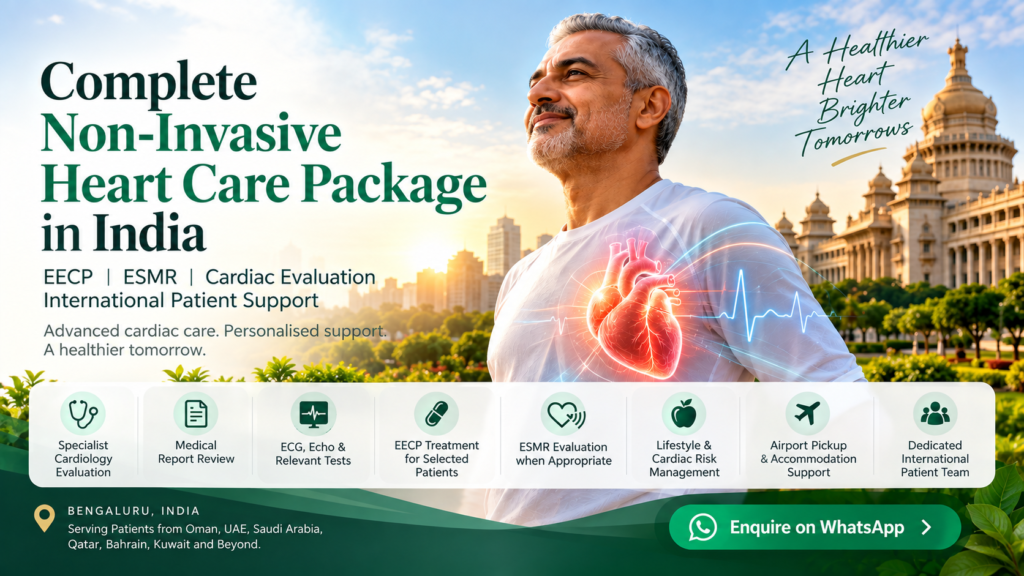
At Nuva Medical Tourism, we help international patients coordinate cardiac evaluation and treatment planning in Bengaluru, India, including non-invasive cardiac-care options when medically appropriate.
What Is a Complete Non-Invasive Heart Care Programme?
A complete non-invasive heart care programme should not simply mean booking a course of EECP sessions.
Proper cardiac care starts with understanding the patient’s condition.
A personalised programme may involve:
- Review of previous cardiac reports
- Cardiologist consultation
- ECG and echocardiogram review
- Angiogram or CT coronary angiogram review where available
- Assessment of previous stents or bypass surgery
- Medication review
- Blood-pressure and cholesterol assessment
- Cardiac-risk evaluation
- EECP suitability assessment
- ESMR evaluation where clinically appropriate
- Lifestyle and exercise guidance
- Cardiac rehabilitation support where indicated
- Follow-up planning
The exact programme varies from patient to patient.
Who May Look for Non-Surgical Heart Treatment in India?
Patients enquire about non-invasive cardiac care for many different reasons.
Some have recently been diagnosed with coronary artery disease and want another cardiology opinion before deciding on treatment.
Others have previously undergone:
- Angioplasty
- Coronary stenting
- Bypass surgery
- Long-term medical treatment
but continue to experience symptoms such as chronic chest discomfort or reduced exercise tolerance.
Non-invasive treatment may also be discussed in selected patients for whom additional invasive revascularization is not considered suitable.
The 2023 American Heart Association/American College of Cardiology chronic coronary disease guideline states that EECP may be considered for symptom relief in patients with refractory angina who have no other treatment options.
That is very different from saying every patient with a coronary blockage can avoid surgery.
Step 1: Cardiology Evaluation and Medical Report Review
The first step should be a proper review of the patient’s cardiac history.
International patients can usually begin by sharing available medical records before travelling.
Useful reports include:
- Recent cardiologist consultation
- ECG
- Echocardiogram
- Coronary angiogram
- CT coronary angiogram
- Stress-test reports
- Myocardial perfusion scan, where available
- Previous angioplasty records
- Stent details
- Previous bypass surgery report
- Current medication list
- Blood investigations
- Discharge summaries
A specialist review helps determine whether the patient needs further investigation and which treatment pathway should be considered.
A preliminary opinion based on uploaded reports does not replace a direct physical examination.
Step 2: Understanding the Coronary Disease
“Heart blockage” is a common term patients use for narrowing of the coronary arteries.
However, treatment cannot be selected simply according to a percentage written on an angiogram.
Doctors may consider factors such as:
- Location of the coronary narrowing
- Number of vessels involved
- Severity of narrowing
- Presence of myocardial ischemia
- Heart pumping function
- Severity and frequency of angina
- Previous heart attack
- Previous stents or bypass surgery
- Diabetes
- Kidney function
- Age and overall health
- Current medication
- Whether further revascularization is technically appropriate
This is why two patients who both have “70% blockage” may receive very different treatment recommendations.
Step 3: Medication and Cardiac Risk-Factor Management
Non-invasive cardiac care does not mean stopping standard medical treatment.
For people with chronic coronary disease, evidence-based medical management remains fundamental.
Depending on the individual patient, a cardiologist may address:
- Cholesterol management
- Blood-pressure control
- Diabetes management
- Anti-anginal medication
- Antiplatelet therapy when appropriate
- Smoking cessation
- Physical activity
- Nutrition
- Weight management
Current chronic coronary disease guidance continues to emphasize healthy dietary habits, physical activity, appropriate medication and cardiac rehabilitation for eligible patients.
Patients should never stop prescribed cardiac medication simply because they are beginning EECP or another non-invasive therapy.
Step 4: EECP Treatment for Selected Patients
What Is EECP?
Enhanced External Counterpulsation (EECP) is a non-invasive outpatient treatment primarily used in selected patients with chronic stable or refractory angina.
During treatment, inflatable cuffs are placed around the lower legs, thighs and pelvic region.
The system synchronises cuff inflation and deflation with the patient’s heartbeat using ECG monitoring.
The cuffs inflate during the resting phase of the cardiac cycle and release before the heart contracts.
Unlike angioplasty, EECP does not require a catheter to be inserted into the coronary arteries.
Unlike bypass surgery, it does not involve an incision or open-heart operation.
Cleveland Clinic describes EECP as a non-invasive outpatient therapy for chronic stable angina, particularly for certain patients whose symptoms persist despite other treatments or who are not suitable candidates for invasive procedures.
How Long Is an EECP Programme?
A commonly used EECP course totals approximately 35 treatment hours.
One frequently used schedule is:
1 hour per day × 5 days per week × 7 weeks
Alternative scheduling may sometimes be used depending on the treating centre and patient’s condition.
The medical team should determine the actual course rather than assuming every patient needs exactly the same schedule.
Who May Be Evaluated for EECP?
EECP may be considered in selected patients with conditions such as:
- Chronic stable angina
- Refractory angina
- Persistent angina despite medical treatment
- Recurrent symptoms following previous angioplasty or stenting
- Persistent symptoms after previous bypass surgery
- Limited options for further invasive revascularization
Eligibility requires appropriate cardiovascular assessment.
EECP is not designed for acute unstable chest pain or a suspected heart attack.
Does EECP Remove Heart Blockage?
No.
This is one of the most important points for patients researching heart blockage treatment without surgery in India.
EECP does not mechanically remove cholesterol plaque from a coronary artery.
It does not physically open a stenosed artery in the way that angioplasty and stenting can.
EECP is used primarily to improve symptoms and circulation in appropriately selected patients.
Some patients may experience fewer episodes of angina and improved ability to perform physical activity, but individual responses vary.
It should therefore not be advertised as a guaranteed “blockage removal” therapy.
Can EECP Replace Angioplasty or Bypass Surgery?
Not universally.
Some patients genuinely require angioplasty, stenting or coronary artery bypass grafting because of their coronary anatomy, symptoms and overall clinical risk.
For those patients, delaying necessary treatment in an attempt to avoid a procedure can be dangerous.
EECP becomes particularly relevant when a patient has chronic or refractory symptoms and established treatment options have already been considered.
The decision must be made by a cardiologist.
Step 5: When ESMR May Be Considered
What Is ESMR?
Extracorporeal Shockwave Myocardial Revascularization (ESMR) is a non-invasive cardiac shockwave therapy.
It uses low-energy acoustic shockwaves directed toward selected areas of ischemic heart muscle under imaging guidance.
There is:
- No surgical incision
- No coronary catheter during the treatment
- No implantation of a device in the coronary artery
The technology has mainly been investigated for patients with chronic myocardial ischemia and refractory angina.
Recent clinical reviews report improvements in angina symptoms, exercise tolerance and quality of life in some studies, while also emphasizing that larger, well-controlled studies are still needed to establish long-term efficacy and durability.
EECP vs ESMR: What Is the Difference?
Although both are non-invasive therapies, they work differently.
EECP
Uses externally applied pneumatic cuffs around the lower body that inflate and deflate in coordination with the heartbeat.
Its main established role is symptom relief in appropriately selected patients with refractory angina.
ESMR
Uses low-energy acoustic shockwaves directed toward selected ischemic areas of the myocardium.
Research into cardiac shockwave therapy has reported encouraging outcomes in selected refractory-angina populations, but the evidence base remains less established than standard coronary treatments.
Neither therapy should be chosen merely because a patient wants to avoid surgery.
The underlying cardiac condition must first be evaluated.
Can EECP and ESMR Be Part of the Same Cardiac Programme?
Potentially, but not automatically.
A non-invasive heart care programme can involve evaluation for different therapies, but the cardiologist should decide whether:
- EECP is appropriate
- ESMR should be considered
- Only medical management is needed
- Further testing is required
- Angioplasty is necessary
- Bypass surgery should be considered
- Cardiac rehabilitation is appropriate
The phrase “complete non-invasive heart care package” therefore refers to coordinated evaluation and care rather than a fixed combination that every patient receives.
Lifestyle and Cardiac Rehabilitation Support
Long-term heart care does not end when an EECP session is completed.
A comprehensive programme should also address modifiable cardiovascular risks.
Depending on the patient, this may involve guidance regarding:
- Walking and physical activity
- Cardiac rehabilitation
- Heart-healthy nutrition
- Blood-pressure management
- Cholesterol control
- Diabetes management
- Weight management
- Sleep
- Smoking cessation
- Medication adherence
These measures remain important whether the patient receives EECP, angioplasty, bypass surgery or medical management.
What May Be Included in a Complete Non-Invasive Heart Care Package in India?
Depending on clinical suitability and the services selected, international patient coordination may include:
Cardiac Evaluation
- Specialist cardiology consultation
- Medical report review
- ECG
- Echocardiography
- Review of angiogram or CT coronary angiogram
- Review of previous stent/bypass reports
- Additional investigations where required
Treatment Planning
- Medication review
- Cardiovascular risk assessment
- EECP suitability evaluation
- ESMR evaluation when clinically appropriate
- Lifestyle recommendations
- Cardiac rehabilitation planning where indicated
Non-Invasive Therapy
Where suitable:
- EECP treatment programme
- ESMR/cardiac shockwave therapy when advised
- Monitoring during therapy
- Follow-up cardiology assessment
International Patient Services
Nuva Medical Tourism can assist with:
- Medical-report coordination
- Doctor appointment scheduling
- Preliminary programme planning
- Airport pickup
- Accommodation assistance
- Local transportation
- Arabic-language assistance subject to availability
- Appointment coordination
- Follow-up support
How Long Should an International Patient Stay in India?
The required stay depends on what the cardiologist recommends.
A patient visiting only for:
- cardiac consultation,
- investigations, or
- a second opinion
may require a relatively short stay.
A patient undergoing a complete EECP programme may need a longer period because EECP is typically delivered over multiple sessions.
Patients considering India for non-invasive heart treatment should therefore obtain a preliminary treatment schedule before booking return flights.
Non-Invasive Heart Care in Bengaluru for Gulf Patients
Nuva Medical Tourism supports international patients travelling from countries including:
Oman • UAE • Saudi Arabia • Qatar • Bahrain • Kuwait
Bengaluru provides access to cardiologists, diagnostic facilities and specialised cardiac-care services while also offering accommodation options for patients requiring an extended stay.
Instead of travelling immediately, Gulf patients can begin by sending their existing medical reports.
This allows the coordination team to determine which specialist should review the case and whether additional information is needed before travel.
What Should International Patients Send for Initial Review?
Patients considering a complete non-invasive heart care package in India should send whatever recent cardiac records are available.
Ideally:
- Patient’s age
- Country
- Current symptoms
- Existing diagnosis
- Coronary angiogram
- CT coronary angiogram, if available
- ECG
- Echocardiogram
- Stress-test report
- Previous angioplasty/stent details
- Previous bypass report
- Current medication
- Recent blood reports
- Doctor consultation notes
Do not delay your enquiry simply because one report is unavailable.
The medical team can advise whether additional investigations are needed.
Can Patients Get a Second Opinion Before Travelling?
Yes.
For international patients, obtaining a preliminary cardiac review before travelling can be particularly useful.
The review may help clarify:
- What the reports indicate
- Whether further tests are required
- Whether non-invasive therapies should be evaluated
- Whether invasive treatment still needs to be considered
- Approximate treatment duration
- Expected stay in Bengaluru
- Next steps
Where available, an online specialist consultation may also be coordinated.
The final recommendation can change after direct examination.
Who Should Not Delay Emergency Heart Treatment?
A medical-tourism enquiry is appropriate for planned cardiac evaluation and elective treatment.
It is not appropriate for an emergency.
Patients should seek immediate local emergency medical attention for symptoms such as:
- New or severe chest pain
- Chest pain occurring at rest
- Rapidly worsening chest pain
- Severe breathlessness
- Fainting
- Sudden heavy sweating with chest discomfort
- Symptoms suggesting a heart attack
Do not wait to travel to India or start EECP when an acute coronary syndrome is suspected.
EECP is not a treatment for unstable angina or an ongoing heart attack.
Why Personalised Cardiac Evaluation Matters
Searching online for “non-surgical heart treatment” can sometimes create the impression that a patient simply has to choose between EECP, ESMR, angioplasty or bypass surgery.
Cardiac medicine does not work that way.
The correct approach is:
Diagnosis → Risk Assessment → Cardiology Evaluation → Treatment Decision → Follow-Up
For one patient, medical therapy may be sufficient.
For another, angioplasty may be appropriate.
Another may require bypass surgery.
And for a carefully selected patient with persistent chronic angina and limited conventional options, EECP or another non-invasive strategy may be considered.
The objective should not simply be “avoid surgery.”
The objective should be to find the most appropriate treatment pathway for the patient.
Start Your Cardiac Evaluation With Nuva Medical Tourism
If you or a family member is exploring non-surgical heart treatment in India, you can begin before booking travel.
Send the patient’s available cardiac reports to Nuva Medical Tourism.
Our international patient-support team can help coordinate:
- Medical report review
- Cardiology consultation
- EECP evaluation
- ESMR evaluation where appropriate
- Treatment and stay planning
- Airport pickup
- Accommodation assistance
- Local transportation
- Arabic-language assistance
- Follow-up coordination
Nuva Medical Tourism
Bengaluru, India
WhatsApp: +91 95350 47727
Request Your Personalised Non-Invasive Heart Care Plan
Send your cardiac reports on WhatsApp to begin the evaluation process.