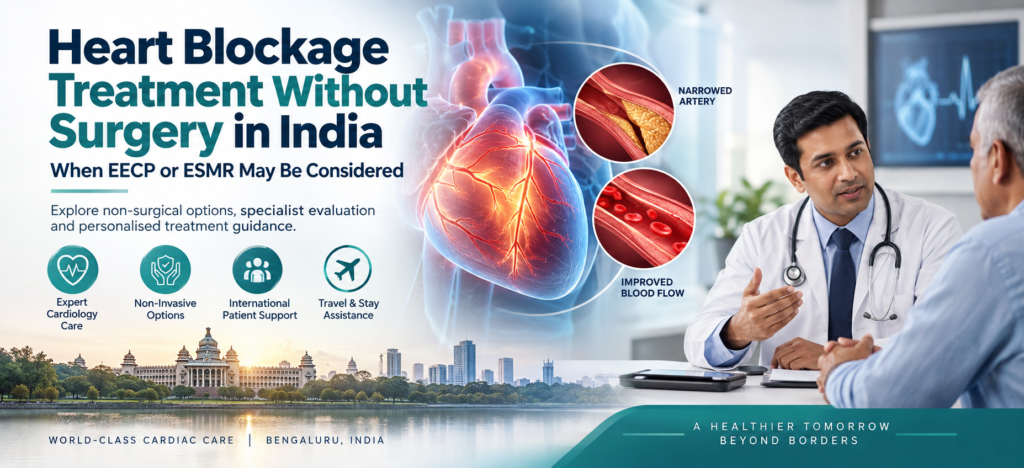
Being told that you have a heart blockage or coronary artery disease can naturally raise concerns about angioplasty, stents or bypass surgery. However, not every patient follows exactly the same treatment pathway.
Depending on the severity and location of coronary artery disease, symptoms, previous treatments, heart function and overall medical condition, a cardiologist may consider different treatment approaches.
For selected patients with chronic stable angina or persistent symptoms despite standard medical treatment, non-invasive therapies such as Enhanced External Counterpulsation (EECP) may sometimes be considered. Another technology, Extracorporeal Shockwave Myocardial Revascularization (ESMR), has also been studied for selected patients with chronic myocardial ischemia and refractory angina.
This guide explains what patients searching for heart blockage treatment without surgery in India should understand about EECP, ESMR, cardiology evaluation and the limitations of non-surgical treatment options.
What Is Heart Blockage?
The term “heart blockage” is commonly used to describe narrowing or obstruction in the coronary arteries that supply oxygen-rich blood to the heart muscle.
This usually develops because of the buildup of plaque within the artery walls, a process associated with coronary artery disease.
When blood flow becomes inadequate, a patient may experience symptoms such as:
- Chest pain or pressure
- Chest heaviness during physical activity
- Shortness of breath
- Reduced exercise tolerance
- Unusual tiredness
- Discomfort spreading to the arm, shoulder, back, neck or jaw
However, symptoms alone cannot determine the percentage or seriousness of a coronary blockage. Proper cardiac evaluation is necessary.
Does Every Heart Blockage Require Surgery?
No. The appropriate treatment depends on the individual patient.
Cardiologists may consider a combination of:
- Lifestyle and risk-factor management
- Medication
- Cholesterol and blood-pressure management
- Antiplatelet or other cardiac medication when indicated
- Angioplasty and coronary stenting
- Coronary artery bypass grafting (CABG)
- Cardiac rehabilitation
- Selected non-invasive symptom-management therapies
A non-surgical therapy should therefore not automatically be viewed as a replacement for angioplasty, stenting or bypass surgery.
The cardiologist must first determine the patient’s coronary anatomy, level of ischemia, symptoms, heart function and overall risk.
What Is EECP Treatment?
Enhanced External Counterpulsation (EECP) is a non-invasive outpatient therapy that has been used primarily in selected patients with chronic stable or refractory angina.
During EECP treatment, inflatable cuffs are placed around the patient’s lower legs, thighs and pelvic area. These cuffs inflate and deflate in coordination with the patient’s heartbeat.
The treatment is designed to influence circulation during the cardiac cycle and improve blood-flow dynamics without inserting a catheter or performing surgery.
A standard EECP programme commonly involves multiple outpatient sessions over several weeks, although the exact protocol should be determined by the treating medical team.
Who May Be Considered for EECP?
EECP may be discussed for selected patients who have persistent chronic angina despite appropriate medical treatment, particularly when further invasive revascularization is not suitable or symptoms continue following previous cardiac procedures.
Examples may include selected patients with:
- Chronic stable angina
- Refractory angina
- Coronary artery disease with persistent symptoms
- Recurrent angina following previous angioplasty or stenting
- Persistent symptoms following previous bypass surgery
- Limited options for additional invasive revascularization
Eligibility cannot be determined from symptoms or an angiogram alone. A cardiologist should review the complete medical history and relevant investigations.
Can EECP Remove Heart Blockages?
This is an important distinction for patients researching non-surgical heart treatment in India.
EECP should not be described as a treatment that physically removes plaque or mechanically opens a blocked coronary artery in the way that angioplasty and stenting can.
The purpose of EECP in appropriate patients is primarily related to improving symptoms and cardiovascular circulation dynamics. Some patients with refractory angina may experience improvement in symptoms or exercise tolerance, but individual responses vary.
Therefore, advertising EECP as a guaranteed way to “clear heart blockage” or permanently replace bypass surgery would be medically inappropriate.
What Is ESMR Treatment?
Extracorporeal Shockwave Myocardial Revascularization (ESMR), also referred to in the literature as cardiac shockwave therapy, is another non-invasive approach that has been investigated for patients with chronic myocardial ischemia and refractory angina.
During treatment, low-intensity acoustic shockwaves are directed toward selected ischemic areas of the heart using cardiac imaging guidance.
The therapy is designed to deliver controlled acoustic energy to the targeted myocardial area without an incision or catheter-based coronary intervention.
How Does ESMR Differ From EECP?
Although both therapies are non-invasive, they work differently.
EECP
EECP uses externally applied pressure cuffs on the lower body that inflate and deflate according to the cardiac cycle.
ESMR
ESMR uses low-energy acoustic shockwaves targeted toward selected areas of ischemic heart muscle under imaging guidance.
The available clinical evidence and guideline support are also different. EECP has a more established role for symptom relief in selected patients with refractory angina, while ESMR remains a more specialised therapy with a comparatively limited evidence base.
Who May Be Evaluated for ESMR?
ESMR has mainly been studied in patients with chronic refractory angina and documented myocardial ischemia, particularly when symptoms persist despite medical therapy and conventional revascularization options are limited.
A complete cardiology assessment is essential before considering this therapy.
The treating team may evaluate:
- Coronary artery disease history
- Angina severity
- Previous angioplasty or bypass surgery
- Evidence of myocardial ischemia
- Heart pumping function
- Current medications
- Other cardiovascular conditions
- Overall treatment objectives
EECP vs ESMR: Which Treatment Is Better?
There is no universal answer.
EECP and ESMR are different technologies and should not be selected simply because a patient wishes to avoid surgery.
The first question should be:
What is medically appropriate for this patient’s coronary disease?
A cardiologist should first determine whether the patient requires medication optimisation, angioplasty, bypass surgery or another established treatment.
Only after that assessment should selected non-invasive therapies be discussed where appropriate.
What Tests May Be Required Before Considering Non-Surgical Heart Treatment?
The exact tests depend on the patient’s condition. A cardiologist may review or request investigations such as:
- ECG
- Echocardiogram
- Coronary angiogram
- CT coronary angiogram
- Stress testing
- Myocardial perfusion imaging when appropriate
- Blood investigations
- Previous angioplasty or stent reports
- Previous bypass-surgery records
- Current medication list
International patients should ideally organise their recent reports before requesting treatment planning in India.
Can EECP Be Considered After Angioplasty or Bypass Surgery?
Some patients continue to experience chronic angina after previous angioplasty, stenting or bypass surgery.
For selected patients whose symptoms remain despite appropriate medical therapy and where additional intervention is not suitable, a cardiologist may evaluate whether EECP could be considered for symptom management.
A previous cardiac procedure by itself does not automatically make someone eligible for EECP.
Is EECP a Replacement for Bypass Surgery?
No. EECP should not be promoted as a universal substitute for bypass surgery.
CABG may be recommended when the location and severity of coronary disease, symptoms and clinical risk make surgical revascularization appropriate.
For some patients, delaying necessary angioplasty or bypass surgery in favour of an unsuitable alternative treatment could be dangerous.
EECP may instead be considered in specific clinical situations, particularly for chronic refractory symptoms when other treatment options have already been evaluated.
Benefits of a Non-Invasive Treatment Approach
When clinically appropriate, one reason patients enquire about EECP or ESMR is that these therapies do not require open-heart surgery.
Potential practical advantages may include:
- No surgical incision
- No general anaesthesia for the therapy itself
- Outpatient treatment
- No catheter inserted into the coronary arteries during treatment
- Usually no hospital admission for the treatment sessions themselves
- Ability to continue many normal daily activities between sessions
These practical characteristics do not mean the therapies are appropriate for every heart patient.
Safety and Medical Evaluation
Before beginning EECP or ESMR, patients should undergo an appropriate cardiovascular assessment.
Certain medical conditions can make a particular therapy unsuitable or require additional precautions.
Patients should therefore disclose:
- Previous heart attack
- Current or changing chest pain
- Heart rhythm disorders
- Heart-valve disease
- Blood-pressure problems
- Peripheral vascular disease
- History of blood clots
- Pacemaker or implanted cardiac devices
- Previous angioplasty
- Previous bypass surgery
- Current medications
- Other significant medical conditions
When Chest Pain Requires Urgent Medical Attention
Non-surgical cardiac therapies are intended for appropriately evaluated patients and should never delay emergency treatment.
New, severe, rapidly worsening or unusual chest pain — particularly pain occurring at rest or accompanied by severe breathlessness, sweating, fainting or other concerning symptoms — requires urgent medical assessment.
A patient experiencing a possible heart attack should seek emergency medical care locally rather than travelling for elective EECP or ESMR treatment.
Heart Blockage Treatment Without Surgery in India for International Patients
India receives international patients seeking cardiology consultations, second opinions and treatment planning.
For patients from Oman, the UAE, Qatar, Saudi Arabia and other Gulf countries, the first step should ideally be a review of existing cardiac reports rather than immediately booking travel.
Recent reports can help the medical team understand:
- The patient’s diagnosis
- Previous cardiac procedures
- Severity and location of coronary disease
- Current symptoms
- Heart function
- Whether additional investigations are required
- Whether EECP, ESMR or another treatment pathway should be discussed
How Nuva Medical Tourism Supports International Heart Patients
Nuva Medical Tourism supports international patients who are considering cardiac evaluation and treatment in Bengaluru, India.
Our patient-coordination services can assist with:
- Organising available medical reports
- Coordinating cardiology consultations
- Specialist and hospital appointment support
- Online consultation coordination when available
- Preliminary treatment and stay planning
- Airport pickup arrangements
- Accommodation assistance
- Local transportation coordination
- Arabic-language communication assistance subject to availability
- Follow-up coordination
How International Patients Can Start
Patients interested in EECP treatment in India, ESMR treatment in India or other non-surgical cardiac options can begin by sharing their available medical information.
Useful reports may include:
- Recent cardiologist consultation
- ECG
- Echocardiogram
- Coronary angiogram or CT coronary angiogram
- Previous stent details
- Previous bypass-surgery report
- Stress-test results
- Current medication list
- Recent blood investigations
A preliminary review can then help determine the appropriate next step. Final treatment recommendations can change following direct examination and additional investigations.
Conclusion
Patients searching for heart blockage treatment without surgery in India should understand that there is no single non-invasive treatment suitable for every coronary blockage.
EECP may be considered for selected patients with chronic or refractory angina, particularly when symptoms persist despite standard treatment and further invasive revascularization is not appropriate.
ESMR is another non-invasive technology being studied and used in selected settings for chronic myocardial ischemia and refractory angina, although its evidence base is more limited.
Neither treatment should be presented as a guaranteed method to remove coronary plaque or universally replace angioplasty or bypass surgery.
The safest approach is to begin with a cardiology evaluation based on the patient’s symptoms, reports, coronary anatomy, previous treatment and overall health.
Looking for a Cardiac Second Opinion in India?
International patients can share their available cardiac reports with Nuva Medical Tourism for specialist-consultation and treatment-coordination support in Bengaluru.
Nuva Medical Tourism
Bengaluru, India
WhatsApp: +91 95350 47727
Medical Disclaimer: This article is for general educational information and international patient-coordination purposes. It is not a diagnosis or a recommendation for a particular treatment. EECP, ESMR, angioplasty, bypass surgery, medication and other cardiac treatments require evaluation by qualified medical professionals. Patients with new, severe or worsening chest pain should seek urgent medical care locally.
Frequently Asked Questions
Common questions about EECP, ESMR and non-surgical heart treatment options in India.
Can heart blockage be treated without surgery?
Some patients with coronary artery disease can be managed with medication, lifestyle and risk-factor management, while others require angioplasty, stenting or bypass surgery. Selected patients with chronic refractory angina may also be evaluated for non-invasive therapies such as EECP. The appropriate treatment depends on coronary anatomy, symptoms, heart function and overall clinical risk.
Does EECP remove heart blockage?
EECP does not mechanically remove coronary plaque or open an artery in the same way as angioplasty and stenting. It is primarily used as a non-invasive therapy to help manage symptoms in appropriately selected patients, particularly those with chronic or refractory angina.
Can EECP replace bypass surgery?
EECP is not a universal replacement for bypass surgery. Some patients require CABG because of the location and severity of coronary disease. EECP may be considered for selected patients whose angina persists despite medical therapy and who have limited or unsuitable options for further invasive revascularization.
Who may be suitable for EECP treatment?
EECP may be evaluated for selected patients with chronic stable or refractory angina, particularly when symptoms remain despite appropriate medical treatment or when additional invasive treatment is not considered suitable. A cardiologist must determine individual eligibility.
Can EECP be considered after angioplasty or bypass surgery?
Some patients continue to experience chronic angina after previous stenting or bypass surgery. In selected cases, a cardiologist may consider EECP when symptoms remain despite appropriate medical management and further intervention is limited or unsuitable.
What is ESMR treatment for the heart?
ESMR, or Extracorporeal Shockwave Myocardial Revascularization, is a non-invasive therapy that uses low-intensity acoustic shockwaves targeted toward selected ischemic areas of the heart under imaging guidance. It has been studied mainly in patients with chronic myocardial ischemia and refractory angina.
Is ESMR better than EECP?
They are different therapies and cannot be ranked as universally better or worse. EECP has a more established role in selected patients with refractory angina, while the evidence supporting ESMR is more limited. Treatment should be selected after a cardiology evaluation rather than according to patient preference alone.
Is EECP treatment painful?
EECP is non-invasive and does not involve surgery or insertion of a cardiac catheter. Patients experience repeated pressure from the cuffs around the lower body. Individual comfort varies, and the treatment team should be informed about any significant discomfort or other symptoms.
How many EECP sessions are required?
EECP is usually delivered as a course of multiple outpatient sessions over several weeks. The exact number and schedule should be determined by the treating cardiologist and EECP team according to the patient’s condition and treatment protocol.
What reports should international patients send before travelling to India?
Useful documents can include a recent cardiology consultation, ECG, echocardiogram, coronary angiogram or CT coronary angiogram, stress-test or myocardial-perfusion reports, previous stent or bypass records, current medication list and recent blood investigations.
Can Gulf patients obtain a cardiac second opinion before travelling to India?
Yes. Available medical reports can first be organised for specialist-review coordination. Depending on the case and specialist availability, an online consultation may also be arranged before travel. The final treatment plan may change after direct examination and additional investigations.